
Property listing monitor
Finds sellers who keep cutting prices and switching agents
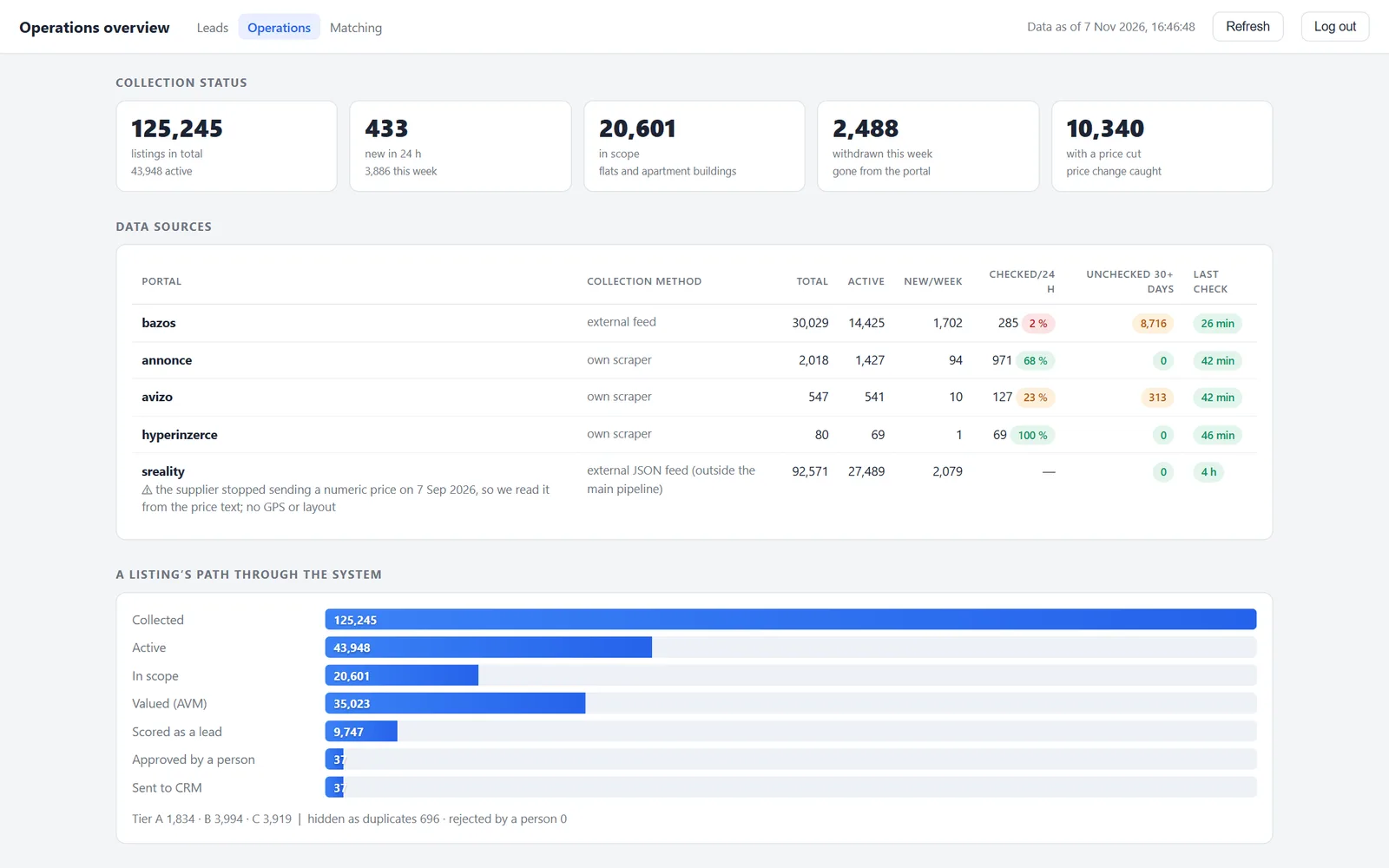
A property investor is looking for sellers who cut prices, pull listings and switch agencies. The system follows listings from five sources, remembers their history and picks those cases out.
In numbers
- listings in the database
- 107,829
- Source: The system's operations dashboard, as of 10 Oct 2026
- properties linked from 9,249 listings
- 3,476
- Source: The system's operations dashboard, as of 10 Oct 2026
Challenge
A property investor isn't looking for a cheap flat, or for one that has been on the market a long time. They are looking for change: the seller cuts the price, pulls the listing, relists a week later with another agency and cuts again. You only see that trajectory if you have the history.
Portals don't show history, and one property is often listed several times, on different portals and through different agents. Tracking that by hand is not realistic.
Solution
We built a system that keeps collecting listings from five sources. On every pass it tidies the listings into one format, spots the agent, estimates the price, merges duplicates across portals, learns from cases a person approved or rejected, and checks whether the listing is still up.
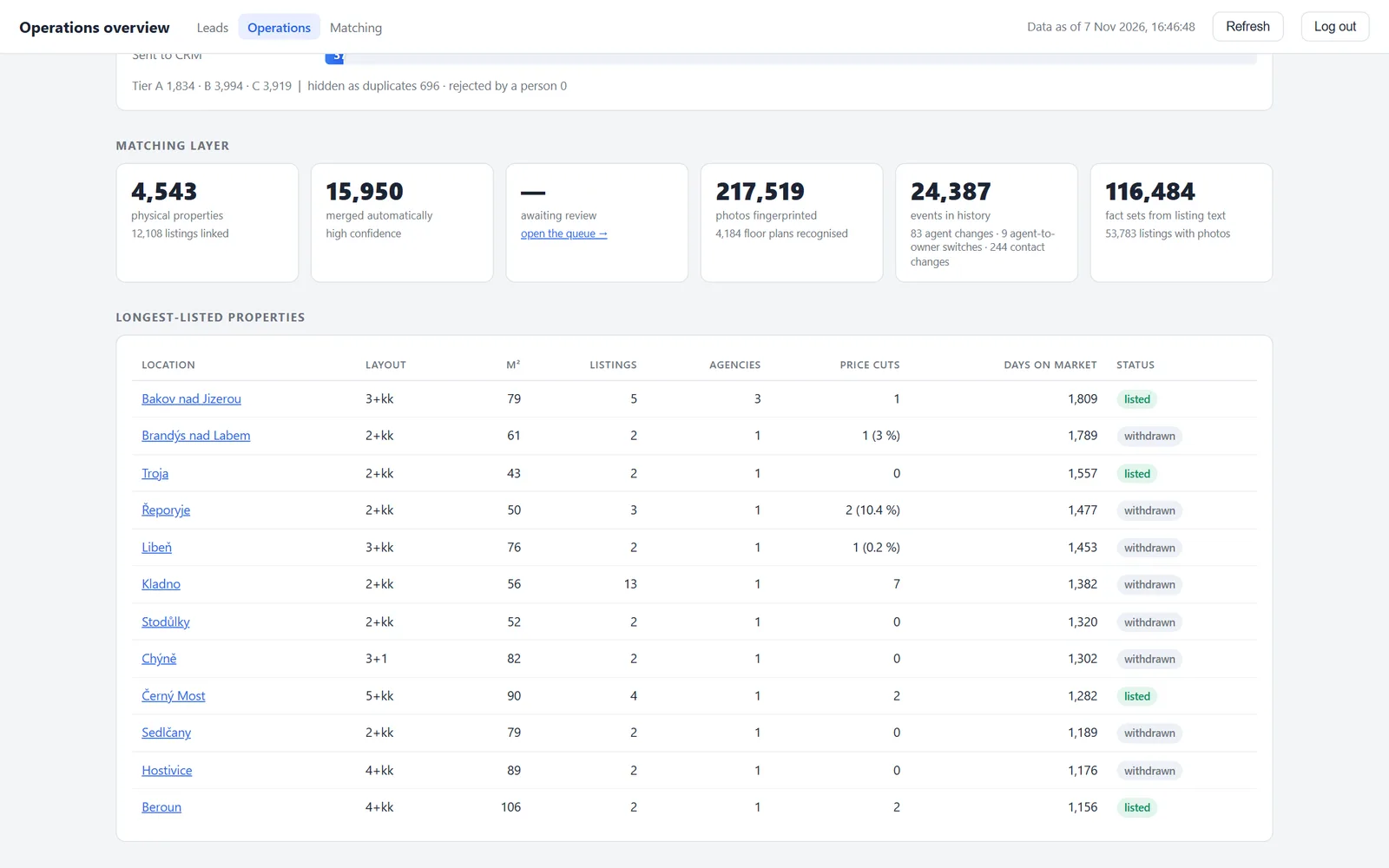
Listings of the same property are linked using details from the text, matching photos and recognised floor plans. Each property then keeps a history: price changes, withdrawals, relistings, a switch to another agency.
The score for how keen a seller is to sell follows the client's brief, and each case shows why it was picked. The client has their own view with saved filters, and new listings that match a filter go straight into their CRM.
How it works
- 1
Collect
The system keeps pulling in new listings and watches for withdrawn ones.
- 2
Match
Listings of the same property are merged using the listing text, photo fingerprints and floor plans together.
- 3
History
Every change of price, agent or status is stored as an event.
- 4
Score
The system rates how the seller's behaviour is shifting and picks a small number of strong cases.
- 5
Hand over
A case approved by a person, or matching a client filter, goes to the CRM.
What it does
- Five listing sources in one place
- Cross-portal linking of listings for the same property
- Photo matching and floor-plan recognition
- Price and event history for every property
- Agent detection, including agency-to-owner switches
- A seller score that shows what it is based on
- Operations view: what each source brought in and how the last pass went
- Saved client filters with automatic delivery to the CRM
Outcome
The system runs for a client who invests in property in Prague and the Central Bohemian Region. Instead of trawling portals, the client gets a short list of cases where the seller is changing price or approach.
So far a person has approved and sent dozens of cases to the CRM. The aim is roughly 32 to 40 of the strongest cases a month, which the client then checks by hand in the land registry.
Contact